Case study
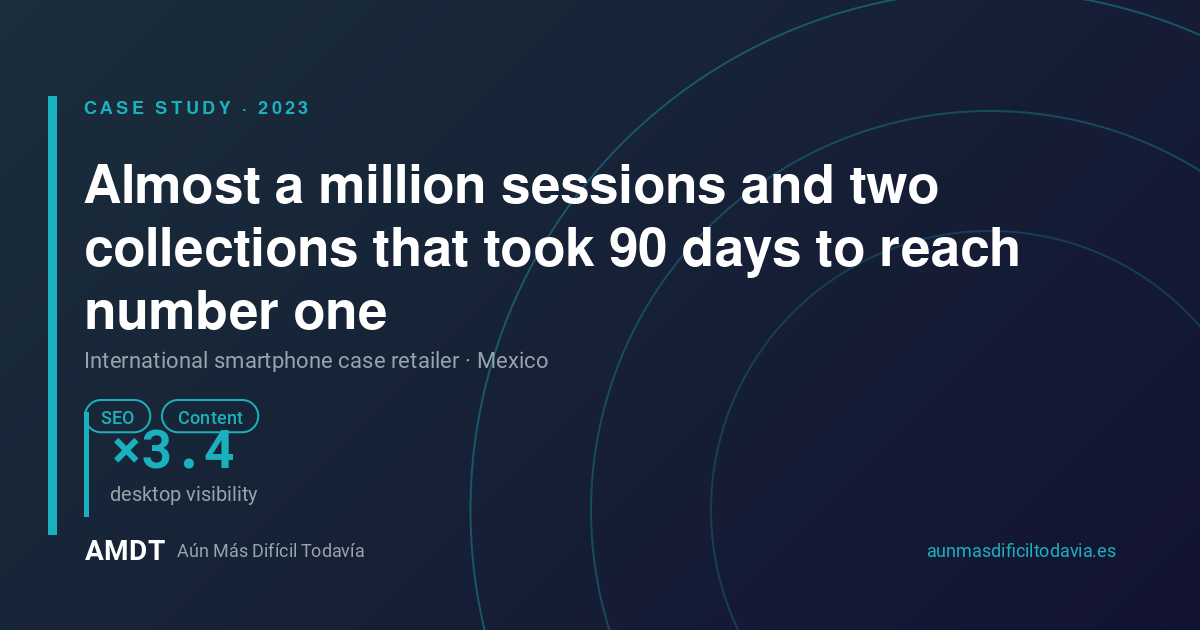
Almost one million sessions and two collections that took 90 days to reach number one
International smartphone case retailer · Mexico · A 34-month project and a lesson in how to communicate in each country
Do you remember when in Spain they used to say ‘móvil’ and in Mexico they were already saying ‘celular’? Well, that subtle difference, which might seem like nothing more than an after-dinner anecdote, is worth money. Quite a lot, in fact.
In the brand’s Mexican market, we measured something that doesn’t appear in any SEO manual: the word ‘funda’ is searched for sixteen times more often than ‘carcasa’. Sixteen to one. In Spain, the ratio is different. And the catalogue had been written, to a large extent, using the wrong vocabulary.
Thirty-four months after launch, the project had accumulated 964,111 organic sessions and thirty-one keywords in the top spot on Google Mexico. Let’s begin:
×3.4
desktop visibility
4 → 31
keywords ranked No. 1
+106%
monthly organic sessions
964,111
Cumulative organic sessions
1. The starting point: a ‘silent’ catalogue
When tracking began in October 2023, this was the situation:
- Visibility of 13.8 per cent on desktop and 12.7 per cent on mobile across a panel of 93 keywords.
- 16 keywords in the Top 3, 51 in the Top 10 and just four in the number one position. Average position: 28.9.
- Share of voice of 2.4 per cent and domain rank in Mexico at #7,627.
- 14,088 organic sessions in July 2024 (GA4).
- And in the on-page audit of April 2026, the phrase that sums it up: ‘empty meta descriptions and meta keywords across the entire website; titles containing only the generic product name; H1 duplicating the title; image alt text identical to the product name’. Zero product schema in the catalogue.
2. What we did: writing in Mexican Spanish
The technical side was as expected — metadata, heading hierarchy, image attributes, URL consistency. The interesting part was the linguistic aspect. Let me explain 🙂
In the Powerpuff Girls collection, the question was whether to name the characters in English or Spanish. It was resolved using data, not judgement: the Spanish names account for 4,400 searches a month, whilst the English ones account for fewer than thirty. We opted for a bilingual H1 — ‘original name (Spanish name)’ — to capture both without causing keyword cannibalisation.
The two collections we worked on in depth in April 2026:
- Classic Animation Licence: 19 URLs (1 category and 18 products), 42 keywords researched for the Mexican market, complete metadata and the four image variants for each product documented.
- Licence A: 15 URLs (1 category and 14 products) and 47 keywords, with the same delivery format.
- Incidentally, an inconsistency was spotted that nobody had noticed before: seven Tough phone cases had ‘Tough’ in the URL, the title and the og:title, but ‘Sublimated’ in the H1 and the breadcrumb trail.
3. The results
| Metric | Before | After | Source |
|---|---|---|---|
| Visibility · desktop | 13.8% | 47.2% | Semrush · est. |
| Visibility · mobile | 12.7% | 38.0% | Semrush · est. |
| Keywords in the Top 3 (out of 93) | 16 | 63 | Semrush PT |
| Keywords in the Top 10 | 51 | 75 | Semrush PT |
| Keywords in 1st position | 4 | 31 | Semrush PT |
| Average position | 28.9 | 10.7 | Semrush PT |
| Share of voice | 2.4% | 14.8% | Semrush · est. |
| Domain rank in Mexico | #7,627 | #4,447 | Semrush · est. |
| Organic sessions (month) | 14,088 (Jul-24) | 29,039 (Jul-26) | GA4 · measured |
| Organic sessions (12 months) | 264,877 | 388,134 | GA4 · measured |
| Licence A enquiry | outside the Top 100 | position 2 | Semrush PT |
| Licence B enquiry | outside the Top 100 | position 1 | Semrush PT |
October 2023 as the baseline and July 2026 as the end date. The last two rows correspond to the collections delivered in April 2026: they rose from outside the top 100 results to positions 1 and 2 in less than ninety days.
Those last two rows are, for us, the most telling part of the case: a three-month window, an identifiable intervention and a jump from outside the Top 100. It’s the closest thing to a controlled experiment that this line of work offers. So, when you’re presented with a case, always ask about the window: without fixed dates, any rise can be attributed to anything.
4. What was left out
Clearly, not everything rises at the same time. The ‘accessories + brand’ cluster was the only one to see a decline during the period, and a significant pool of demand went uncaptured: ‘tempered glass’, with 5,400 searches per month, finished in 36th place.
I recommend that you insist your agency keeps records of actions just as rigorously as they do of results: without knowing what was done and when, a rising graph is a lucky coincidence rather than a method that can be replicated in the next market.
In summary: why does a translated catalogue fail?
Basically, because translating is not the same as localising. A catalogue that says ‘mobile’ in a country where they say ‘mobile phone’ is, technically, well written. But commercially, it’s meaningless.
Three things before your morning coffee. Firstly, I’d assess the actual vocabulary of your market before translating anything: the proportion of synonyms, not just the frequency of the main term. Secondly, I’d sort out the internal inconsistencies — those seven phone cases that were referred to in two different ways on the same page — because they confuse the search engine just as much as they do the customer. And thirdly, I’d choose two collections as a test case and set a deadline: if they don’t sell within ninety days, the problem wasn’t the content.
Remember, at the end of the day, it’s all about writing the way your customers speak 😉

