
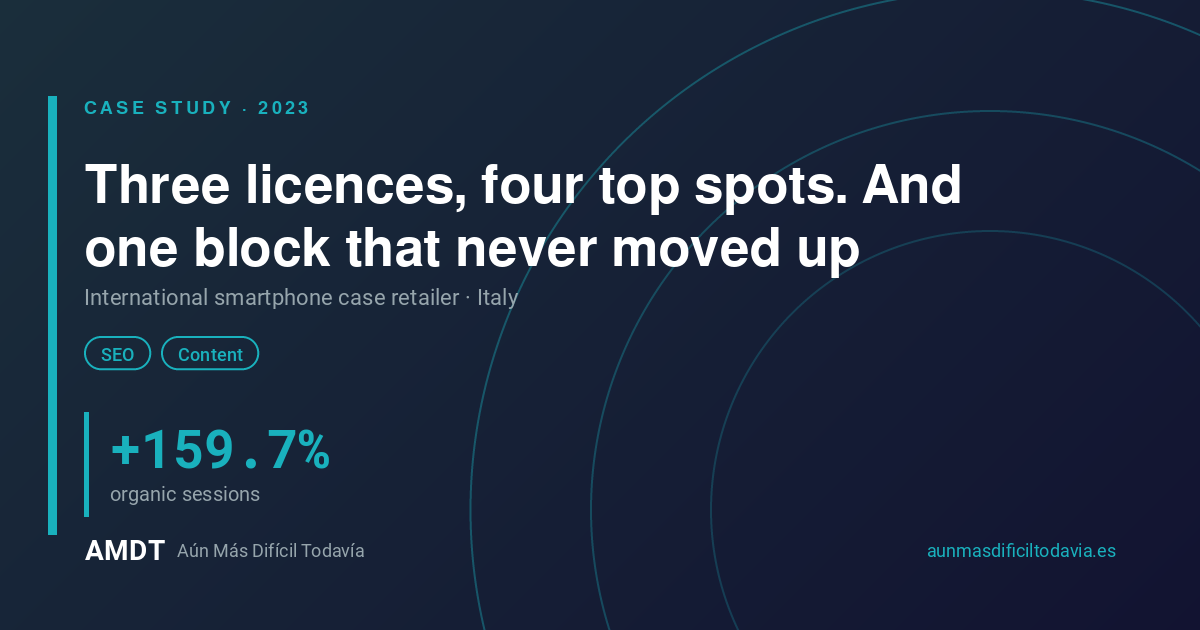
Case study
Three licences, four top positions. And one block that failed to rank
International smartphone case retailer · Italy · The case where causality was demonstrated by accident
In March 2026, the Italian market hit rock bottom. Estimated organic traffic stood at 61,756 visits, the lowest in a fifteen-month period, and the average desktop ranking had fallen to 16.3. The ‘official licences’ tag — covering three universes of licensed characters — had zero keywords in the Top 10.
Four months later, the four licensed keywords being monitored were ranked number one on Google Italy: all four licensed character queries in the panel. And the top result appeared ahead of Amazon, with our meta description visible in the result.
But that is not what makes this case study valuable. It is the section that the client never got round to implementing. Let’s begin:
+159.7%
organic sessions
55 → 347
organic conversions per month
0 → 4
top-ranking keywords
16.3 → 8.9
average desktop position
1. The starting point: a site with no metadata and an LCP of fourteen seconds
The snapshot from February–March 2026, when the intensive phase began:
- Average position of 16.3 on desktop and 16.2 on mobile; the lowest point in the series came on 25 March with just 18 keywords in the Top 3.
- Zero keywords in the Top 10 for both the ‘licences’ and ‘charms and accessories’ tags.
- Systematically empty metadata: 15 out of 15 meta descriptions missing for licence A, 8 out of 8 for licence B.
- Desktop LCP of 13.81 seconds (January–March 2026), with 1,064 dead clicks in the customiser and over 1,268 JavaScript errors in the accessories catalogue.
- The organic channel was the site’s second-largest, with 28,698 sessions and 55 conversions in March (GA4).
2. What we did: four collections, one by one
The method was identical across all four: extracting the actual page content, conducting keyword research using Semrush and DataForSEO based on the Italian market, drafting metadata and image attributes, delivering the work to the client, and carrying out a follow-up audit to verify what had actually been implemented.
That final step is the one almost nobody does. And it’s what turned this project into a showcase.
There was also one finding that deserves a mention of its own. Let me explain 🙂
When analysing Italian search demand, we discovered that ‘cover viola’ — a purple cover — had 140 searches per month, practically the same as the generic term ‘headboard’. People in Italy search by colour. We changed the titles and H1 tags of the ‘Purple’ products to use ‘Viola’, and that decision now appears as the number one result for ‘cover kuromi’.
The full scope of the work:
- Licence A (15 URLs), Licence B (8 URLs), Charms and Tracolle (20 URLs) and Licence C —the classic animation licence— with its own character study.
- A sixty-day UX audit using GA4 and Microsoft Clarity: ten sections, thirteen recommendations and a technical report for development with ten classified issues (two critical, five high, three medium).
- Google Ads account audit — 50 campaigns, 85 ad groups — and monthly reporting from February to June.
- Implementation of brand exclusions on 30 March to measure organic traffic, excluding users who were already searching for the brand by name.
3. The results
| Metric | Before (Mar-26) | After (Jul-26) | Source |
|---|---|---|---|
| Organic sessions | 28,698 | 74,531 | GA4 · measured |
| Organic conversions | 55 | 347 (Jun) / 281 (Jul) | GA4 · measured |
| Organic channel ranking | 2nd channel | 1st site channel | GA4 · measured |
| Estimated organic traffic | 61,756 (minimum) | 82,492 (maximum) | Semrush · est. |
| Average position · desktop | 16.3 | 8.9 | Semrush PT |
| Average position · mobile | 16.2 | 8.2 | Semrush PT |
| Keywords in the Top 3 | 23 | 31 | Semrush PT |
| Top 10 Licences | 0 | 4, all four at No. 1 | Semrush PT |
| Charms in the Top 10 | 0 | 2 | Semrush PT |
| Generic Apple terms in the Top 10 | 0 | 2 (both at No. 2) | Semrush PT |
On 30 July 2026, a live check was carried out using DataForSEO on Google.it: the search for licence A appeared in position 1, ahead of the global marketplace; the search for licence B appeared in position 1 with the colour variant; ‘tracolla per cellulare’ appeared in position 2; and a third licence appeared on the first page. In all four cases, the metadata drafted by AMDT had been indexed.
Not included in the table is an improvement that does not fall within this timeframe and is therefore reported separately: the desktop LCP fell from 10.9 to 3.4 seconds (−68%) following the technical team’s intervention, verified in March 2026. The baseline measurement for January–March had reached 13.81 seconds.
4. The block that wasn’t uploaded: the experiment we weren’t looking for
The charms and accessories package was submitted in the same way as the others: twenty URLs with their full metadata. The ‘tracolle’ section was implemented and is now ranking — ‘tracolla per cellulare’ rose from 48th place, linking to the homepage, to 5th place in its correct category. The ‘portachiavi’ section was not. Only three of the twenty URLs were live, none of the twenty had an H1 tag, and one of them returned a 404 error.
Result of the unimplemented sub-block: no rankings.
What was uploaded occupies the top positions on Google Italy. What was delivered but not uploaded does not appear. Same team, same method, same month, same domain, even the same delivery document. The only variable that changes is whether the work made it onto the website.
It’s also worth mentioning the flip side. The categories we didn’t work on lost ground: ‘accessories’ went from three keywords in the Top 10 to zero, and the total number of ranked keywords fell from 63 to 58. It’s clear that concentrating your efforts comes at a cost. That’s why this cost is included in the main body of the report rather than in a footnote.
To sum up: what’s the point of a deliverable that isn’t published?
Basically, nothing. And this is probably the most costly lesson in the sector: a large proportion of the SEO work invoiced each month in Spain never makes it into production.
If I had to safeguard a project tomorrow, I’d do three things. First, I’d include post-launch verification within the scope itself, not as an extra. Second, I’d measure the actual implementation rate as if it were a project KPI, because it is. And third, I’d look for those words in local search queries that nobody on the marketing team uses — such as ‘viola’ in Italy — because that’s often where the legitimate shortcut lies.
Remember, at the end of the day, it’s all about the work making it onto the page, not into a shared folder 😉

