Case study
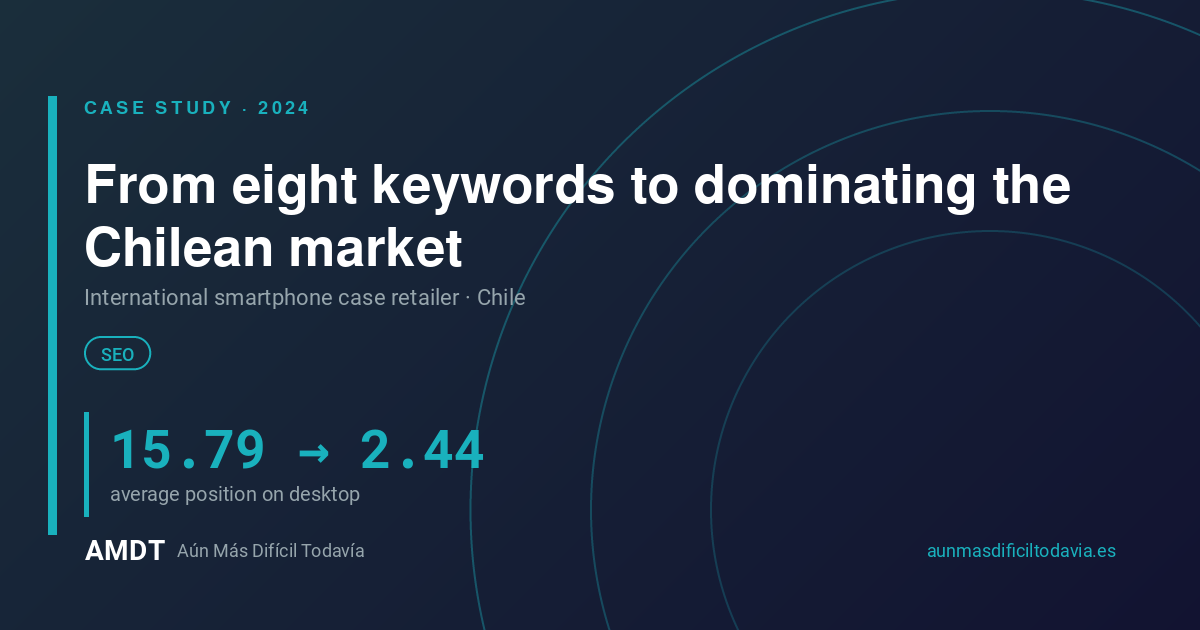
From eight keywords to dominating the Chilean market
International smartphone case retailer · Chile · 22 months building a domain from scratch
Some projects are inherited, whilst others are built from scratch. This was one of the latter: in April 2024, the brand’s Chilean domain existed merely as a web address with eight ranked keywords. No authority, no history, no backlinks. A plot of land surrounded by hoardings.
When we wrapped up the project on 30 July 2026, the average desktop ranking was 2.44 and the brand was in the Top 3 for 40 of the 53 keywords monitored, across both devices.
And there’s one figure which, quite frankly, is the one we’d show if we could only show one. You’re about to see it. Let’s begin:
15.79 → 2.44
average desktop position
13 → 43
keywords in the Top 3 (out of 53)
5% → 92%
market demand captured
+54.6%
organic sessions for the half-year YoY
1. The starting point: an entire market ahead of us
Starting from scratch has one advantage that nobody mentions: you don’t have to dismantle anything. And one obvious disadvantage: everything that appears on the graph has to be added by you.
The screenshot from the first snapshot, in September 2024:
- Average position of 15.79 on desktop (first snapshot, 18 September 2024) and 9.45 on mobile (13 November 2024, when tracking began on that device).
- Only 13 keywords in the Top 3 out of the 53 in the tracking dashboard.
- Estimated organic traffic of 3,223 visits/month and 941 organic keywords (Semrush, Chile-based).
- Domain rank in Chile: #20,378.
- Of the 12,440 monthly searches within the scope of the project, the brand was capturing just 660 per month in the Top 10. That’s 5 per cent.
2. What we did: consistency, not fireworks
With a young domain, the work isn’t spectacular: it’s cumulative. Let me explain 🙂
A coherent category structure, consistent on-page optimisation across the product tree, weekly monitoring of 53 keywords on desktop and mobile, and addressing gaps as they arose. None of this makes for a headline.
I’ve seen many projects fail because of the opposite approach: brilliant content campaigns for three months, followed by nine months of silence. Here, there were 150 tracking snapshots on desktop and 141 on mobile. That, and nothing else, is what sustains growth.
3. The results
| Metric | Before | After | Source |
|---|---|---|---|
| Average position · desktop | 15.79 | 2.44 | Semrush PT |
| Average position · mobile | 9.45 | 2.35 | Semrush PT |
| Keywords in the Top 3 | 13 | 43 out of 53 | Semrush |
| Keywords in the exact No. 1 position | - | 32 desktop / 31 mobile | Semrush PT |
| Traffic captured in the Top 10 | 660 per month (5%) | 11,425 visits/month (92%) | DataForSEO · est. |
| Traffic captured in the Top 3 | 290 b/month | 11,100 per month (89%) | DataForSEO · est. |
| Equivalent value in Ads | 22 USD/month | 644 USD/month | DataForSEO · est. |
| Estimated organic traffic | 3,223 (Sep-24) | 48,926 (Jun-26) | Semrush · est. |
| Organic keywords | 941 | 1,754 (peak 2,623) | Semrush · est. |
| Domain rank in Chile | #20,378 | #2,040 | Semrush · est. |
| Organic channel share | 74.6% (2025) | 81.1% (2026) | GA4 · measured |
Start = first snapshot on 18/09/2024 for desktop and 13/11/2024 for mobile. End = 30/07/2026 and 29/07/2026 respectively. The percentage growth in traffic reported by Semrush (+1,418%) is based on a very low baseline, which is why we prefer not to highlight it: for young domains, percentages can be misleading, whereas absolute figures are not.
That is the figure I mentioned: from 5% to 92% of market demand captured in the Top 10. In September 2024, for every hundred searches in the sector in Chile, the brand appeared in the top positions for five of them. By July 2026, this had risen to ninety-two.
In GA4, the project accumulated 379,439 organic sessions. The six-month period from October to March saw a year-on-year increase from 79,508 to 122,885 sessions, a rise of 54.6 per cent, with December 2025 being the best month in the entire series (25,049 sessions).
And one detail that often goes unnoticed in end-of-period reports: zero lost keywords. None of the 53 monitored ended up worse off than when they started. Twenty-four came in from nowhere.
4. What we set out in writing upon completion
A success story that only highlights the positives isn’t a success story: it’s a brochure. It’s clear that no project is ever completed without some loose ends. That’s why the closure report includes what remains to be done and in what order of priority.
What remained outstanding at project closure:
- The backlink profile is minimal: 45 backlinks and 30 referring domains. It maintains the current position, but is a weak point should serious competition emerge.
- A single unresolved ranking gap: ‘iPad case’, with 1,000 searches per month, remained in position 11–12. The demand is there, and we weren’t capturing it.
Both issues were included in the handover document along with their recommendations and priorities, so that whoever takes over knows exactly where to look. I recommend always insisting on this section from any agency that wraps up a project with you: what’s missing says more about the quality of the work than what’s included.
To sum up: what does a new domain teach us?
Basically, that the advantage of starting from scratch is that every point on the graph is yours, with no legacy issues or technical debt from others. And that a market’s true ceiling is measured in captured demand, not in visits.
If I were to launch a new market tomorrow, I’d do three things. First, I’d define the country’s actual search universe before writing a single word — 12,440 searches per month in this case, not a single one more. Second, I’d track data from day one across both devices, because in Chile the gap between desktop and mobile was six positions at the start and nine hundredths by the end. And third, I’d write down everything I don’t have time to do.
Remember, in the end it’s all about turning a plot of land with hoardings into an address that people can type from memory 😉

