
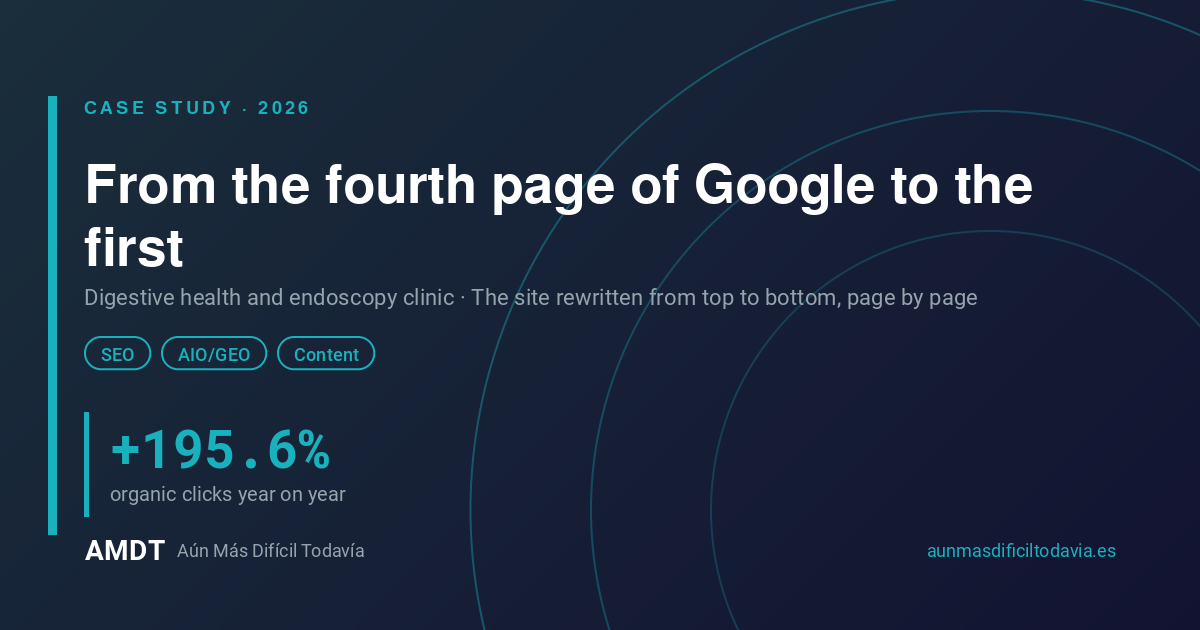
Case study
From the fourth page of Google to the first
Gastroenterology and Endoscopy Clinic · The website rewritten from top to bottom, page by page
In private healthcare, there’s a problem that advertising can’t solve: people search for their symptoms, not their clinic. They type ‘gastroscopy preparation’ at eleven o’clock at night, three days before the procedure, scared out of their wits. And whoever answers that query well gets the patient.
When we audited this site in March 2026, the average ranking was 32.35: the fourth page of results. Nobody was getting there.
Today it’s 8.69. Organic clicks for the quarter rose from 476 to 1,407 year-on-year, and impressions from 62,124 to 202,887. Let’s begin:
+195.6%
year-on-year organic clicks
32.35 → 8.69
average ranking
12 → 470
clicks on the featured page
24 / 24
rewritten pages on the site
1. The starting point: a site that looked healthy on the outside but was lifeless on the inside
The March 2026 audit returned an overall score of 35 out of 100, with the following details:
- 963 clicks and over 205,000 impressions in 90 days, with a CTR of 0.49 per cent. The clinic appeared very frequently but nobody was clicking on it: a classic sign of being in positions where people no longer look.
- A canonical loop that was blocking the sector’s most in-demand content cluster.
- Mobile LCP of 17.3 seconds and design scroll depth of 0.443. A medical website that takes seventeen seconds to load is one that nobody will wait for.
- Out of 434 crawled URLs, only 22 were indexable. And a blog with just five posts in a sector where trust is earned through writing.
- Huge gaps in content: two medical conditions with nearly 50,000 and 60,000 monthly searches, respectively, without a single page covering them.
- And in terms of visibility within AI-generated responses: 7 mentions compared to 145 for the direct competitor.
2. What we did: rewrite the entire site
Not just a part of it. The entire site. All 24 pages, divided into three priority waves and delivered one by one, each with its own document.
Let me explain 🙂 on a medical website, it’s not enough simply to ‘improve the text’. Each page needs to be authoritatively written by an identifiable specialist, have a structure that answers the specific question the patient is asking, feature internal links connecting symptoms to tests and tests to treatments, and include structured data that tells the search engine what type of content it’s reading.
The complete package:
- A ten-phase SEO audit using eight data sources, plus a final report for the client.
- A three-tier keyword study and strategy — traditional search, AI-generated answers and cross-referenced FAQs — with 22 pages mapped to your primary keyword and five secondary keywords.
- All 24 pages rewritten with the specialist’s signature, including an SEO block, internal linking, structured data, a change log and quality control, one by one.
- Technical development guidelines with full details: canonical tags, redirects, medical clinic schema, FAQs schema and author page.
- Editorial strategy comprising 17 articles across four clusters, with a four-month calendar.
- Research into prompts for monitoring visibility on AI assistants: 60 seed prompts, 32 selected for ongoing monitoring.
3. The results
| Metric | May-Jul 2025 | May-Jul 2026 | Change |
|---|---|---|---|
| Organic clicks | 476 | 1,407 | +195.6% |
| Views | 62,124 | 202,887 | +226.6% |
| Average position | 32.35 | 8.69 | −23.66 |
| CTR | 0.766% | 0.693% | −0.073 pp |
Year-on-year comparison measured in Google Search Console on 2 August 2026. The CTR has fallen slightly because the site now appears in far more searches, many of which are informational and at the top of the funnel: this is the expected trade-off for a 3.3-fold increase in impressions.
The half-yearly comparison confirms that this is not a one-off spike: from November–January to May–July, clicks rose by 84.6% and impressions by 70.4%, with the CTR also improving this time (0.640% → 0.693%).
| Page or search | Before | After | Position |
|---|---|---|---|
| Exam preparation guide | 12 clicks | 470 clicks | - |
| Main exam page | 33 clicks | 239 clicks | 28.9 → 8.2 |
| Oncology page | 12 clicks | 110 clicks | 36.8 → 9.7 |
| Comparison of two conditions | 0 clicks | 121 clicks | - |
| The sector’s go-to resource | 1 click | 82 clicks | 37.8 → 8.6 |
| Secondary pathology consultation | 1 click | 21 clicks | 29.5 → 8.6 |
The pages are described by their function to preserve the client’s anonymity. All figures are actual clicks from Search Console in the year-on-year comparison for May–July.
It’s clear that the star performer is the top result. A guide on how to prepare for a diagnostic test — the least glamorous content imaginable — went from twelve to four hundred and seventy clicks. Because it answers exactly what people are searching for at eleven o’clock at night.
4. What part is attributable to what
Here we need to be precise, because timing matters. The complete rewrite was published from 22 June 2026, so it has only been in the index for about six weeks.
Looking at that specific window—40 days later compared with the previous 40 days—the effect is still modest: +6.7% in clicks and the average position dropping from 8.91 to 8.28. A good sign, but there’s still some way to go.
And a second business-related clarification: all the growth is informational. The commercial pages — those featuring prices — are stagnant. That is why the next phase of the project is not to write more, but to build the bridges leading from the preparation guide to the consultation stage.
I recommend you ask yourself this question in relation to your own organic growth: is it rising where revenue is generated, or where people are simply reading?
To sum up: why doesn’t your clinic appear?
Basically, because it’s written to explain who you are, not to answer the patient’s questions. They’re two different types of text, and only one of them ranks well.
Three things before your morning coffee. First, check your average position in Search Console: if it’s above twenty, you don’t have a conversion problem – you have a visibility problem. Secondly, write the preparation guides, the common concerns and the ‘what if’ scenarios — this is the content nobody wants to create, yet it’s the content that brings in patients. And thirdly, credit each page to the specialist who endorses it: in healthcare, authorship isn’t just a nice touch; it’s equally a ranking factor and a trust signal.
Remember, at the end of the day, it’s all about being where the question is asked 😉

